


 Locations

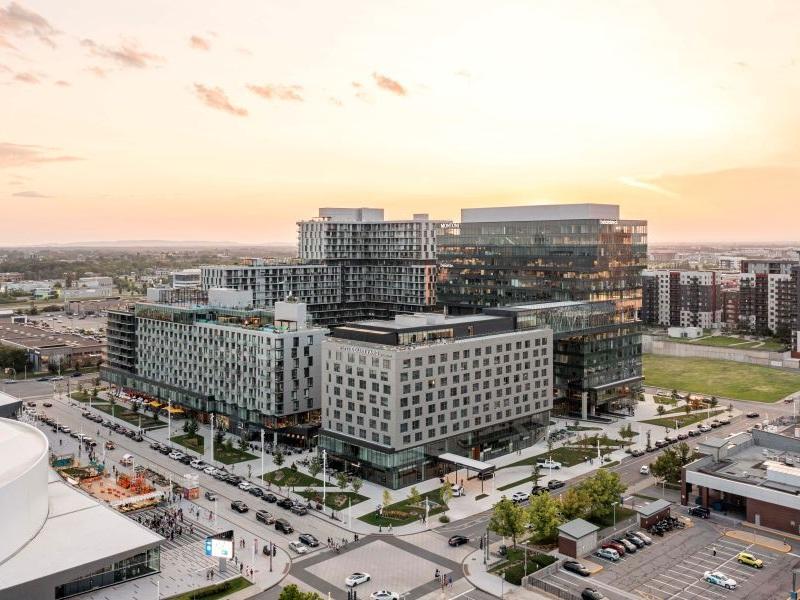



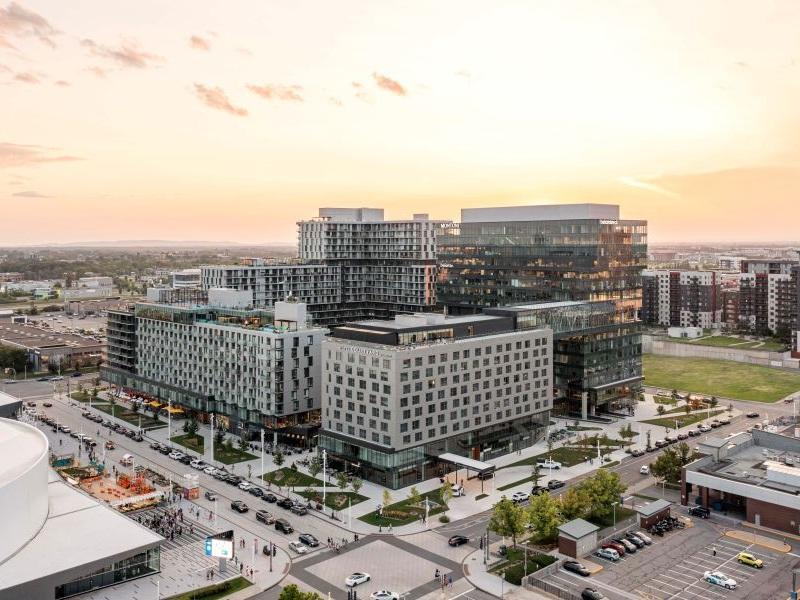
Espace Montmorency, a large mixed-use development in Laval, Que., demonstrates how sustainability can be built into a neighbourhood-scale project while making a strong financial case for doing so.
Located west of Montreal, Espace Montmorency is a 1.3-million-square-foot complex spanning a single city block. It includes more than 700 apartments, office space, 32 shops and a Marriott hotel. Project developer Montoni Group is headquartered in the site.
Also included is an energy loop that recirculates heat throughout its four towers for low-carbon heating and cooling.
Its sustainability features have helped Espace Montmorency become the largest project in Quebec, and the seventh-largest in Canada, to earn the Canada Green Building Council's Zero Carbon Building (ZCB)–Performance certification.
Espace Montmorency represented the “largest and most ambitious project in our history” when development started in 2019, Patrick Côté, Montoni's director of sustainable development, said in an email exchange with Sustainable Biz Canada. It opened an opportunity to rethink what a large-scale urban development could be, particularly regarding sustainability.
“We wanted Espace Montmorency to be more than a successful real estate project,” Côté said. “We wanted it to become a model for how we can build the cities of tomorrow.”
Espace Montmorency's energy loop
At the core of the green features is a fifth-generation energy loop. A thermal plant, described as “the heart of that system” by Côté, combines a network of heat pumps, an electric boiler and other equipment to produce, recover and redistribute energy throughout the complex.
Rather than have each building manage its own heating and cooling, the loop redistributes energy between the towers based on demand. For example, heat generated by cooling commercial spaces can be recovered and redirected to residential areas rather than expelled outdoors.
The energy loop has slashed greenhouse gas emissions by 91 per cent compared to a more conventional means of operating each building independently, Côté said.
Beyond its carbon-reduction measures, Espace Montmorency captures and reuses rainwater for certain non-potable applications and incorporates low-flow water fixtures. The two features have helped reduce potable water consumption by more than 40 per cent.
To encourage use of lower-carbon transportation, the complex offers direct access to the Montréal Métro, cycling infrastructure and electric vehicle charging stations.
The project's sustainability features have earned it several certifications, including LEED Gold for Neighbourhood Development, LEED Platinum for its office spaces, and LEED Gold for its hotel and residential buildings.
The loop is also delivering financial benefits, with Montoni reporting a reduction of more than 50 per cent in the project's energy costs. Montoni expects a return within approximately 10 years from the savings. “You can significantly reduce your environmental footprint while also improving the long-term performance of the asset,” Côté said.
While some systems demanded higher upfront investment compared to a conventional approach, he noted the performance makes it apparent “we’re heading in the right direction.”
Offsetting with carbon credits

While its design and equipment significantly reduce greenhouse gas emissions, they do not eliminate them entirely. Espace Montmorency emitted 975 tonnes of greenhouse gases in 2025. To offset the remainder, Montoni purchased carbon credits audited under Verra’s Verified Carbon Standard. The offsets, derived from forestry and hydroelectric projects, are permitted by the ZCB standard.
The credits balance out the carbon emissions that cannot yet be eliminated, Côté said, particularly those from construction materials and other hard-to-abate sources. Montoni is increasingly relying on Pure, its environmental compensation program, for the credits. Pure focuses on long-term projects in Quebec, such as tree planting, conservation and restoration of natural environments.
Montoni may continue purchasing carbon credits annually to meet specific LEED or ZCB certification requirements, although Côté said the company intends to do so selectively.
The company is looking to further refine the sustainability of Espace Montmorency, through steps like reducing the environmental impact of operations, improved waste management, optimizing energy use and engaging the tenants and users.
'Continue raising the bar'
Sustainable developments like Espace Montmorency are not new to Montoni. Montoni was the first company to build a LEED Gold-certified industrial building in Quebec and has since developed several other sustainability-focused projects, including Écoparc Châteauguay 30, Écoparc Laval 15 and a cultural hub in Laval. Underpinning its work is a goal to be carbon neutral by 2040.
Beyond serving as a milestone for Montoni, Espace Montmorency is also a testing ground where the developer can “test, measure and implement new approaches” for future projects, Côté said.
One example is Quartier Molson in Montréal. It is another mixed-use development, similar to Espace Montmorency, where Montoni is analyzing the integration of an energy loop. The aim is to build on some of the principles the company implemented at Espace Montmorency. That line of thinking applies to Écoparc line, Côté said.
“Not every project will use the exact same solutions as Espace Montmorency,” he said, “but with every new development, we ask ourselves what we can do better and how we can continue raising the bar.”


 Industry Events
 Locations

