
 Locations




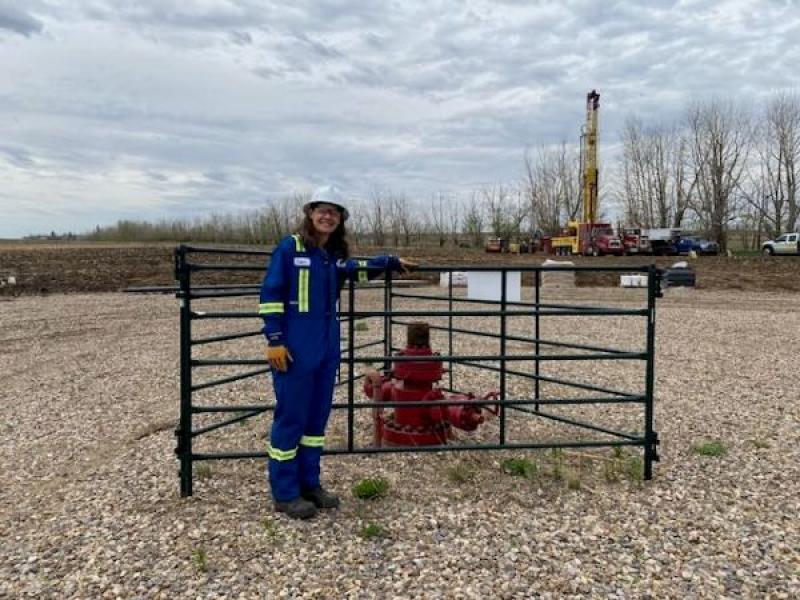
Ground has been broken on the Origins Carbon Capture Storage Hub near Clive, Alta. The project, being developed by Enhance Energy Inc., is set to become Canada’s largest carbon capture and storage (CCS) project when operations begin in 2027.
Announced Wednesday afternoon, the project is to initially have the capacity to store up to 1.5 million tonnes of carbon dioxide (CO2) per year — the equivalent of taking over 500,000 cars off the road, with the possibility of increasing its scope over time.
At the 1.5-million tonne capacity, Origins is expected to be the largest CO2 storage hub in Canada, and one of the largest worldwide.
Origins is planned to store CO2 from heavy industrial sources in Alberta’s Industrial Heartland, serving hard-to-abate industries such as oil and gas, cement, power generation, hydrogen and petrochemicals. The project could connect to central and southern Alberta as well. A pipeline is to connect Origins to Alberta’s CO2 transportation network.
Operations are scheduled to begin January 2027 in Clive, a village located between Calgary and Edmonton.
Origins “builds on Enhance's demonstrated expertise in the safe, permanent storage of carbon emissions,” Candice Paton, its vice-president of corporate affairs, said in the release.
Mitigating the oil and gas industry's operational emissions
That experience includes the Clive CO2 Sequestration Facility, located in the same village where Origins is being built. Calgary-based Enhance says the Clive project has stored over nine million tonnes of CO2 since the first injection in 2020.
The Clive asset has generated over $800 million of carbon credit value, $586 million of economic activity in central Alberta, and backstopped over $1 billion of investment in the carbon capture and sequestration value chain in Alberta, Enhance says.
Origins is supported by two $5-million grants from Natural Resources Canada’s Energy Innovation Program.
The memorandum of understanding between the Canadian and Alberta governments has created a friendly policy environment for Origins, Enhance says. The aim of the memorandum is to produce oil and gas with low carbon intensity, boosting oil and gas production while supporting carbon capture developments to mitigate CO2 emissions. The proposed policies include raising the industrial carbon price over time and developing domestic carbon capture supply chains.
Canada's focus on CCS
Governments in Canada have focused on CCS as a way to reduce the greenhouse gas emissions from the operations of the nation’s biggest source of planet-warming pollution.
In 2024, the oil and gas sector was Canada’s largest source of greenhouse gas emissions, responsible for 30 per cent, according to federal government data. From 1990 to 2024, the sector's emissions rose by 76 per cent — crude oil production more than doubled, particularly from the oilsands which are among the most carbon intensive.
Greenhouse gas emissions in Canada from conventional oil production have increased by four per cent from 1990 to 2024, while the pollution from oilsands production leapt by 529 per cent.
Alberta, where most of Canada’s oilsands are processed and extracted, has been the centre of carbon capture developments such as the Pathways Project, which is designed to have the capacity to transport and store about six million tonnes of CO2 per year of captured CO2 by the mid-2030s. It represents a scaling back from the original ambition of storing 22 million tonnes of CO2 by 2030.
Despite the promise of the technology to balance economic growth and greenhouse gas emissions, CCS has a mixed showing to date. A 2026 study in Petroleum Research examining the carbon capture industry found “poor alignment between cost structures and revenue models” for projects, which contributes to making them “economically unviable without permanent subsidies,” among other technological and economic limitations.
Continued reliance on carbon capture and storage, the authors wrote, “is a high-cost gamble that risks delaying the deployment of truly effective climate solutions.”


 Industry Events
 Locations