
 Locations



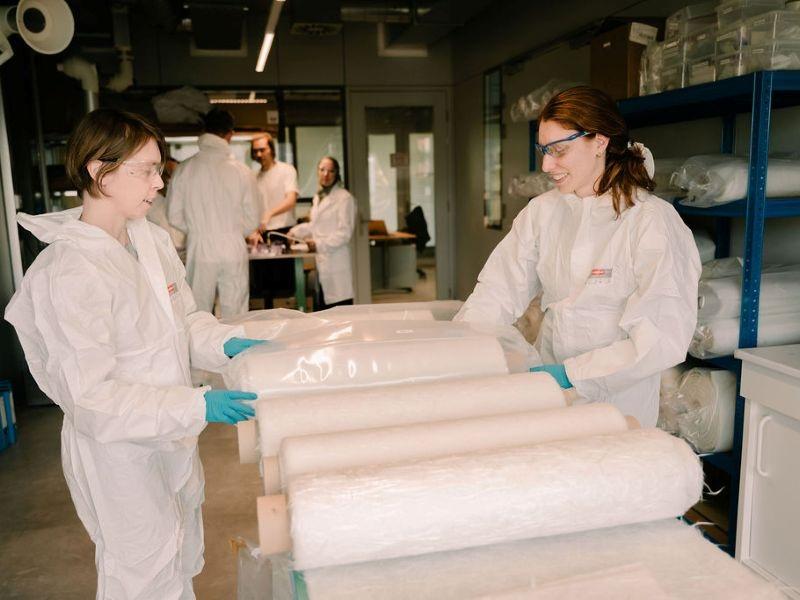
Verretex, a Swiss startup behind a method of chemically upcycling fibreglass, has a Canadian co-founder with a dream to develop a commercial-scale facility in his home country.
Named after the French word for glass (verre) and the “tex” in textiles, Verretex was founded in January 2025 by three scientists based in Switzerland's EPFL Innovation Park. Its CEO and co-founder is Mitchell Anderson, a Canadian with a PhD in physics from Queen’s University.
Fibreglass, a reinforced plastic prized for its durability and light weight, is commonly used in industries like construction, transportation and sporting equipment. Its ubiquity also means thousands of tonnes of it is thrown away every year and left in landfills.
Verretex is aiming to rectify this problem with a process that restores fibreglass into a non-woven textile that can replace newly made fibreglass. This, the company says, translates into a significant reduction in resource consumption and carbon emissions.
“It was a personal interest in solving a recycling problem that was difficult to solve,” Anderson said in an interview with Sustainable Biz Canada. “As a physicist, I like generally just finding the most difficult problem I can solve and try to solve it.”
From quantum physics to recycling
Anderson is a self-described serial entrepreneur who helped found companies like optical sensor and quantum technology firm Miraex and Composite Recycling in Switzerland before starting Verretex.
Being in the recycling business is a major shift for Anderson, whose educational background is in optics and quantum physics. The change in career path reflects his wife’s influence; she is a chemistry PhD also with an entrepreneurial bent who helped found a plastics recycling firm. Anderson said he became “jealous that my wife was saving the world and I was just spending my time in a clean room,” and opted to follow her into the industry.
Another motivating factor is the formative years spent in Northern Ontario, where Anderson grew up sailing in the region dotted with hundreds of lakes. He grew concerned with the tons of waste formed by fibreglass boats being sunk offshore.
With co-founders Nour Halawani and Lidia Rocoffort de Vinnière he formed Verretex, based in Lausanne.
Verretex's recycling process
First, Verretex takes fibreglass from recyclers in a form that resembles cotton balls and subjects it to a chemical mixture which treats the surface. This removes any remaining organic contaminants, repairs the surface and adds a protective coating. Verretex then uses a wet laid process (Anderson said it is similar to paper making) to turn the upcycled fibres into non-woven textiles which it ships to its customers.
Boat hulls, skis, wind turbines, building parts, and oil and gas piping could be made using the Verretex-processed fibres, Anderson said, while producing 80 per cent less carbon emissions compared to producing new fibreglass.
A pilot project with wind turbine manufacturer Ryse Energy was conducted to check if the upcycled fibreglass would have the same performance and processing time as its virgin material-made counterpart when making a wind turbine blade. The companies found the performance matched, with no change to the production time.
Upcycling in Canada

Verretex is currently in an early commercial stage, upcycling fibreglass in Sweden and producing the textiles in Germany. It purchases used fibreglass from recyclers, processes the material and sells the fibreglass to clients in the auto, ski, construction and boating industries that are in search of a more sustainable feedstock.
“We have a lot of different clients that are looking to replace their virgin glass fibre with our sustainable, circular glass fibre,” Anderson said.
Anderson’s ambition is to build a worldwide network of upcycling sites. One idea is to have the facilities nearby sources of fibreglass such as large wind farms or marinas.
Verretex is focused on working with recycling firms with the permits and infrastructure to integrate its technology. But, “you can in theory make it a 40-foot shipping container a recycling unit,” Anderson said about its recycling technology which could be mobile.
The company’s goal is to raise its production capacity to 2,500 tonnes per year by 2028. It is farthest along on a plan for a site of such capacity in Spain, but Anderson said a similar facility could be in Canada with the right partners.
Verretex is negotiating partnerships to join the Canadian market, with the Vancouver area of particular interest. To support its plan in British Columbia, Verretex has struck up a partnership with the Ocean Legacy Foundation, a non-profit which recovers derelict vessels from the province’s coastline, as a feedstock partner.
It is also in talks with the British Columbia government to understand the volumes of fibreglass waste in the province and how much would be recyclable, Anderson said.
Having raised approximately $2 million to date in seed funding, Verretex is fundraising for up to over $17 million in a next raise. It is working on projects with a ski manufacturer and construction industry partner, which are expected to be announced soon, Anderson said.



 Industry Events
 Locations