
 Locations



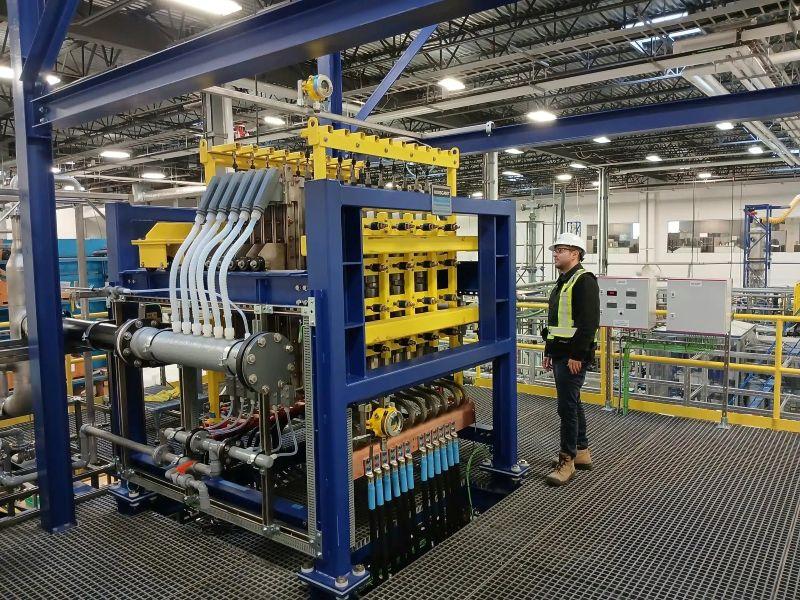
As industrial deployment of its lithium refining technology takes place, Vancouver-based NORAM Electrolysis Systems Inc. (NESI) is working to improve its NORSCAND system with $5.6 million in government funding.
NESI, spun out from NORAM Engineering and Constructors Ltd. in 2022, develops and supplies devices which uses electricity to output lithium, a metal critical to manufacturing batteries.
Its NORSCAND electrolyzers have been deployed in nine industrial-scale demonstration facilities run by its clients in Canada, the U.S. and Europe. Altogether, its systems can produce 4,000 to 5,000 tonnes of lithium per year, showcasing the technology and producing lithium for sale.
To be a leader in sustainable lithium refining, NESI plans to use the funds from the National Research Council of Canada’s Industrial Research Assistance Program and British Columbia’s Innovative Clean Energy Fund to boost the economic case for NORSCAND.
“What this new and improved system will enable is for us to work with more and more refiners who plan new projects in Canada, the U.S. and Europe moving forward,” NESI’s CEO Jeremy Moulson said in an interview with Sustainable Biz Canada.
Enhancing NORSCAND
When two major sources of lithium — hard rock and brines — are processed, the result is an intermediary lithium product, typically lithium chloride or a lithium sulphate aqueous solution.
NORSCAND converts the intermediary products into lithium hydroxide or lithium carbonate by subjecting them to an electrical current. The two compounds are “key components” for making lithium-ion batteries, Moulson said.
Unlike conventional lithium refining, NORSCAND eliminates the need for reagents chemicals, he continued. This means compared to conventional lithium refining, NESI’s technology can cut operating costs by up to 45 per cent.
Not only can it reduce expenses, NORSCAND can shrink carbon dioxide emissions and water consumption by up to five times in comparison to traditional processes, Moulson added.
NESI is directing the $5.6 million in government funding it received to development of a next-generation electrolyzer.
The goal, Moulson said, is to produce a system with lower capital and operating costs than its current platform by making “significant improvements in electrode technologies and overall plant process technology.”
While he would not discuss specific targets for the updated system, Moulson disclosed NESI has its sights set on double-digit improvements in cost and performance. The company has chosen a site for field validation of the enhanced technology expected to take place in the second half of 2028.
Deployments of NESI’s technology
NESI’s business, Moulson said, is selling its electrolyzers and power systems, licensing its technology and designing facilities that house NORSCAND.
The company’s electrolyzers are assembled in its 40,000-square-foot centre in Richmond, B.C. Just across the site is its 50,000-square-foot electrolyzer manufacturing and process module factory.
In 2024, Sustainable Biz Canada reported on NESI receiving funds from Natural Resources Canada to build a test facility in Richmond. Today, it can produce 500 tonnes of lithium hydroxide per year.
Also in 2024, NORSCAND was installed in Vulcan Energy’s Central Lithium Hydroxide Optimisation Plant in Europe. The commissioning of the facility, which can output 500 tonnes of lithium hydroxide per year, marked the first time battery-quality lithium hydroxide was refined in Europe from European resources, Moulson said.
To further develop its relationship with Vulcan, NESI has secured an exclusive supply contract with the company that has offices in Australia and Germany for its Lionheart Project. It represents the first full-scale commercial deployment of NORSCAND, Moulson said.
The in-development facility in Germany is expected to produce 24,000 tonnes of lithium hydroxide per year. That much lithium is enough to produce 500,000 electric vehicle batteries, Moulson said.
Projects like Lionheart can help NESI overcome the barriers to widespread adoption, he said. The company has other large-scale projects in the works, Moulson added.
Sodium sulphate regeneration a potential next step
NESI is exploring other opportunities for sustainable chemical manufacturing and waste treatment. One such opening is regenerating sodium sulphate.
The compound is a byproduct from producing cathode active materials, which are core to making batteries. The problem, Moulson described, is “there is not large enough of an industrial use case for sodium sulphate as lithium battery demand grows.”
To address the waste problem, NESI plans to split the sodium sulphate into sodium hydroxide and sulphuric acid with electricity. The sodium hydroxide and sulphuric acid can then be used as reagents.
This would offset “the need to be producing and trucking in those reagents from other sources, and also eliminates the waste stream of sodium sulphate that is traditionally put out into the environment,” Moulson summarized.
With sustained, high demand for lithium around the world driven by electric vehicles and energy storage, Moulson expects substantial interest in NORSCAND.
“NESI is very well-positioned to expand market share as demand for lithium grows because we are an early mover in this space.”


 Industry Events
 Locations