
 Locations




Group Bel Canada, the maker of Babybel and The Laughing Cow cheese snacks, is supporting steps to cut greenhouse gas emissions from its milk supply with the help of consultancy Logiag.
The Canadian branch of the French dairy company is investing $3.7 million over five years in 34 Quebec dairy farms to address the production of Mini Babybel at its Sorel-Tracy, Que. facility. The project's target is to reduce the greenhouse gas emissions of the milk supply for the product by 30 per cent by 2031, the equivalent of 12,000 tonnes of greenhouse gases.
Approximately 35 per cent of Group Bel’s greenhouse gas emissions originate from its upstream dairy chain, making it a priority for the company, its senior manager of sustainability Jo-Annie Tétreault said.
“Our only door is to influence or to invest with partners that have direct access to farmers, engage farmers that really want to make changes,” she told Sustainable Biz Canada in an interview.
The agricultural industry accounts for approximately 10 per cent of Canada’s greenhouse gas emissions when fossil fuel use and fertilizer production is excluded, the federal government says. The nation’s dairy sector emits about 20 per cent of the greenhouse gases from the main livestock sectors, government data also shows.
An 'economically sound,' 'holistic' project
Described as a “holistic” program by Jacques Nault, co-founder of Châteauguay, Que.-based Logiag, the agricultural consultancy plans to examine the 34 farms’ operations and measure the carbon dioxide, methane and nitrous oxide emissions. It will then work with the farm owners to identify the most effective and financially efficient changes they would be comfortable implementing, and develop a five-year plan per farm.
“The idea of this program is to generate greenhouse gas reductions that processors downstream from the farm can use,” Nault said in an interview with Sustainable Biz Canada. “The most important thing is that farmers are at the centre of our activity and attention.”
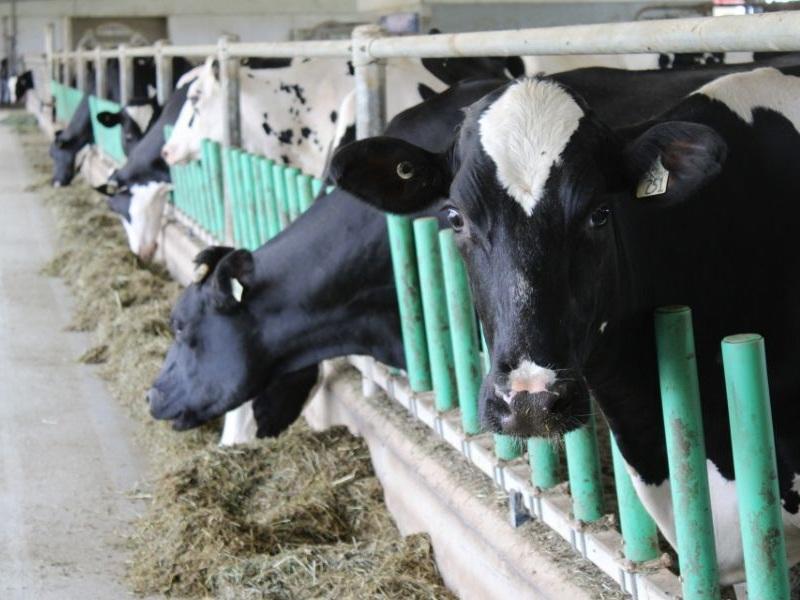
A large source of greenhouse gas emissions from the dairy industry comes from the digestive processes of cows, which add methane to the atmosphere. A way the project will address this is by increasing the number of lactation cycles per heifer. If the cows are producing milk for longer periods, it will mean fewer heifers need to be born and raised. Thus, less methane will be emitted.
“As the cows remain healthy and older . . . they produce more milk per lactation,” Nault explained, which means farmers can hit production quotas with fewer cows.
Manure releases powerful greenhouse gases such as methane and nitrous oxide when left to ferment in pits. Logiag could push farmers to find ways to use manure as fertilizer before the pits get hot in the summer and cause the wastes to rapidly decompose.
Third, Logiag is looking to reduce nitrogen use. Nitrogen, a common fertilizer, transforms into nitrous oxide when exposed to soil. Logiag is aiming to encourage crop rotation practices to reduce the need for mineral nitrogen in fields.
The agricultural practices being promoted in the project are "economically sound," Nault said. For farmers, it means spending less on fertilizer, raising heifers and feed.
Group Bel and Logiag are using a methodology validated by Netherlands-based SustainCERT to measure and verify the expected greenhouse gas reductions from the project.
Group Bel's decarbonization efforts
Group Bel cannot guarantee the milk from the farms will go toward its Sorel-Tracy facility because of Quebec’s supply management system, Tetrault said. But the protocol the project is under permits greenhouse gas reductions in a milk pool to count toward a reduction, Nault said, provided the milk is sourced from the area where the project is taking place.
In a company-wide climate transition plan published in 2025, Group Bel announced absolute greenhouse gas reduction targets for 2035. Those are:
- a 75.6 per cent cut for Scope 1 (direct) and 2 (electricity) emissions; and
- a 25 per cent cut for Scope 3 (supply chain) emissions.
Under three per cent of the company’s planet-warming pollution arose from Scope 1 and 2 sources in 2024, with Scope 3 making up the remainder.
From 2017 to 2024, Group Bel shrank its Scope 1 and 2 absolute emissions by 42 per cent. Taking Scope 3 emissions into account, the overall decrease was 14 per cent.
To cut the emissions from its upstream dairy sourcing, which it laid out in a 2025 document, Group Bel backed the use of feed additives which reduce methane emissions from cows and provided bonuses to milk suppliers that are taking initiative on reducing carbon emissions.
Group Bel reported cutting methane emissions by 26.1 per cent from 2017 to 2023 because of its actions.
The company hopes other “big dairy upstream players” will join its effort to reduce greenhouse gas emissions from dairy sources.
There are other dairy farmers interested in joining the project, Nault said, but more industrial partners must participate to widen its reach.


 Industry Events
 Locations