
 Locations






A technology that allows mobility app users to generate carbon credits from choosing lower-carbon transportation options is the world’s first to be patented, its Vancouver-based developer Greenlines Technology Inc. says.
Patented in Canada in October, Greenlines’ Mobility Carbon Engine (MCE) integrates with mobility apps such as Moovit. When users opt to bike or take the bus rather than drive, it calculates the carbon emission reductions and generates credits. Those credits can be returned to the app's user in the form of money or other incentives.
Co-founded in 2017 by CEO David Oliver, COO Arturo Miguel and co-owner Jonathan Whitworth, Greenlines was formed to create “the tools, the systems, the process to allow an aggregator, which is a mobility app in this case, to produce credits for people on the street,” Oliver said in an interview with Sustainable Biz Canada.
“It’s the first time that we are able to quantify and generate credits from human behaviour,” he said about MCE, which was launched in 2019.
An engineer by trade who held managerial positions at Schneider Electric and Eaton, Oliver said he aimed to simplify the carbon credits sector with Greenlines, and encourage people to make low-carbon transportation choices. Transportation is responsible for over a quarter of Canada’s carbon pollution.
Making carbon credits on Moovit
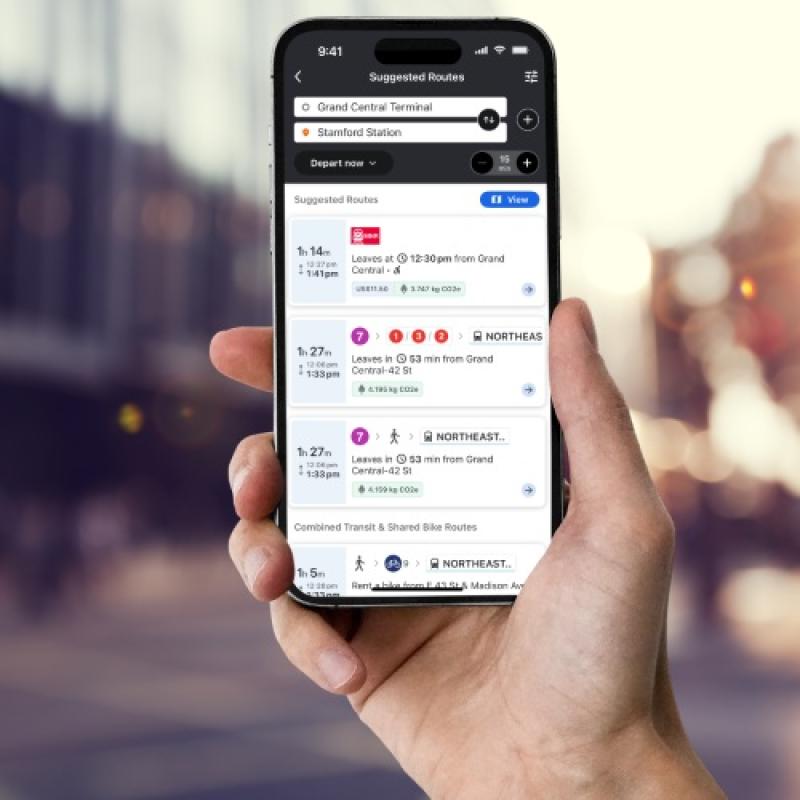
MCE is licensed by Moovit, an urban mobility and route-planning app that its developer says has 1.5 billion users.
To generate carbon credits, a user must first consent to the program. The app then sets a baseline for their transportation mix on Moovit. If the user takes a low-carbon transportation option over their personal baseline, such as public transit or an electric scooter, Moovit will register the mode of transportation per trip and the distance travelled with GPS to verify the trip was completed as planned. MCE will calculate the resulting carbon emissions.
On average, a user saves approximately 1.2 kilograms of carbon dioxide (CO2) per trip using Moovit, its owner Mobileye says.
For every tonne of CO2 emissions saved by a user, Moovit will develop an offset project recognized by a registry. Once audited, the emission savings are converted into a credit issued to Moovit.
Greenlines methodology is recognized by carbon registries such as the Iceland-based International Carbon Registry (ICR) and the Canada-based CSA CleanProjects Registry to issue the credits. To ensure the credits calculated by MCE have legitimacy, Greenlines has its methodology and credits audited by a third-party verification organization approved by the CSA or ICR.
Moovit will sell the credits on the voluntary carbon markets and can return some of the revenue to the user, with a portion of the revenues directed to Greenlines. Alternatively, Moovit can compensate the user through incentives such as an ad-free subscription to the app.
“It’s not going to motivate somebody to travel exclusively with bikes, or walk,” Oliver said about MCE, but the goal is to create an incentive that can encourage people to change their behaviour, he continued.
Moovit is the largest licensee of MCE to date, and Greenlines is working to sign more partnerships, Oliver said.
Expanding the technology's user base
As Greenlines looks to roll out MCE on more platforms, it also offers a similar system in the digital commerce space.
Named the E-commerce Carbon Engine (ECE), it allows e-commerce and transaction platforms to create carbon credits at the point of sale. When a comparatively low-carbon product or service is selected on an e-commerce platform against a baseline, ECE quantifies the difference and generates carbon credits.
As transportation and choice of purchases are responsible for most people's carbon emissions, “this is where the MCE and ECE serves,” Oliver said about the technologies Greenlines developed.
Greenlines is set to announce a licensing deal with a Canadian drone operator and is in talks with major digital marketplaces, he said about ECE. The company also expects demand in Southeast Asia and Europe.
A self-funded company from Day One that has been revenue-positive since 2020, Greenlines is not hunting for funding, Oliver said.
The next big step for Greenlines is to expand its list of anchor clients to two to three big names in 2026, he said. Oliver also plans to release an improved methodology for the MCE, which will help expand the company’s reach to the Middle East and Southeast Asia.
Editor's Note: This article has been corrected to reflect that ECE has already been released and that Moovit is not the sole licensee of MCE. Sustainable Biz Canada regrets the errors.


 Industry Events
 Locations