
 Locations




A report by two green building organizations could provide clarity on how much a deep retrofit would need to cost for Canada's buildings to be on track to net-zero by 2050.
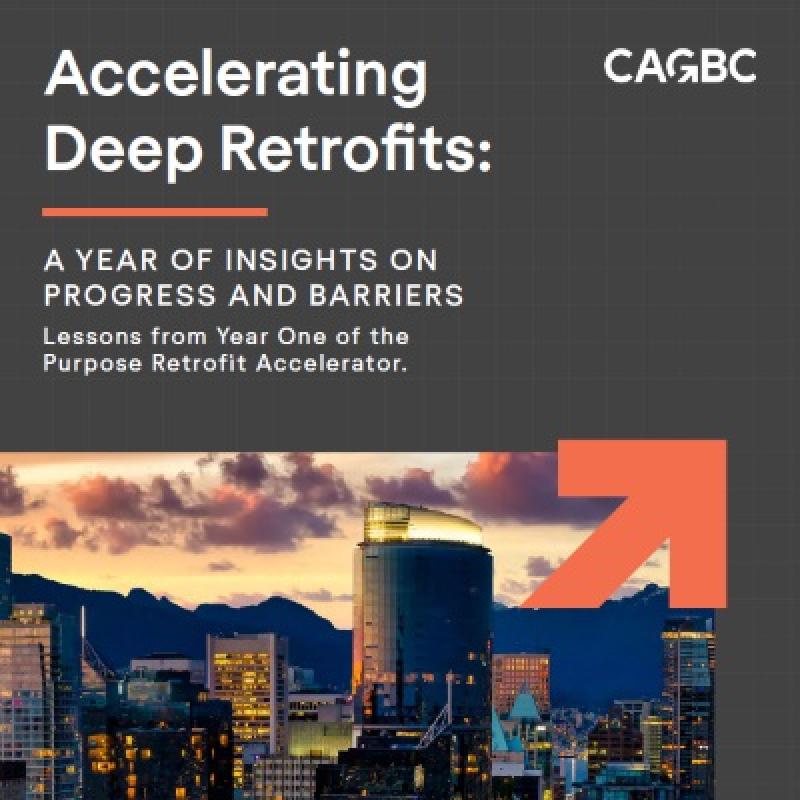
The Canada Green Building Council (CAGBC) and Purpose Building teamed up to release a report titled Accelerating Deep Retrofits – A Year of Insights on Progress and Barriers. It examines the state of Canada’s deep retrofits, which are building upgrades that typically halve energy use and greenhouse gas emissions while enhancing climate resiliency.
Narrowing the first year of a nationwide data set to 16 properties and 135 retrofits, the two groups found an average incremental cost of $10 per square foot for a deep retrofit may be needed to reduce building greenhouse gas emissions by 40 percent by 2030 and be on a pathway to net-zero by 2050.
“We have never before seen clear cost metrics on what deep decarbonization retrofits cost. We want to start an open dialogue about what these things cost,” Eric Chisholm, the principal and co-founder of Toronto-based firm Purpose, said in an interview with Sustainable Biz Canada.
What the accelerator learned
Buildings are responsible for between 13 and 18 per cent of Canada’s greenhouse gas emissions, the Canadian government says, and Chisholm added deep retrofits are critical to unlock a net-zero future. After identifying a need for a faster pace in the adoption of deep retrofits, Purpose and CAGBC launched the Purpose Retrofit Accelerator in 2024. In its first year, the accelerator worked with the owners of over 1,700 buildings.
To better understand the costs of a deep retrofit, the Purpose Retrofit Accelerator formed a dataset of properties that have finished the planning phase and looked for insights, which uncovered the $10-per-square-foot data point.
While there is still uncertainty over the dollar figure, it is a “better starting point than we’ve ever had before,” Chisholm said. Without a number, “nobody was budgeting” for a deep retrofit. Having the value will help organizations put a placeholder in their budgets “until they can arrive at a more building-specific number,” he added.
A firmer idea of the costs is important, given there is perceived uncertainty about the costs and benefits of deep retrofits, Chisholm said, which can deter investment. But he argues the “confidence gap” can be addressed so investors can commit to the upgrades.
The accelerator is aiming to clear the fog in the early stages of a deep retrofit so building owners can bridge the gap. For example, rather than investing in a like-for-like replacement of a building system, it proposes choosing newer, more sustainable options that have more benefits. The perks and costs are calculated and tweaked until the plan can satisfy the building owner. When the retrofit’s wins are clearer to an investor, Chisholm said the confidence gap is overcome.
He also hopes it will spur the industry to bring the dollar figure down by sparking innovation among technology providers.
Epic’s case study
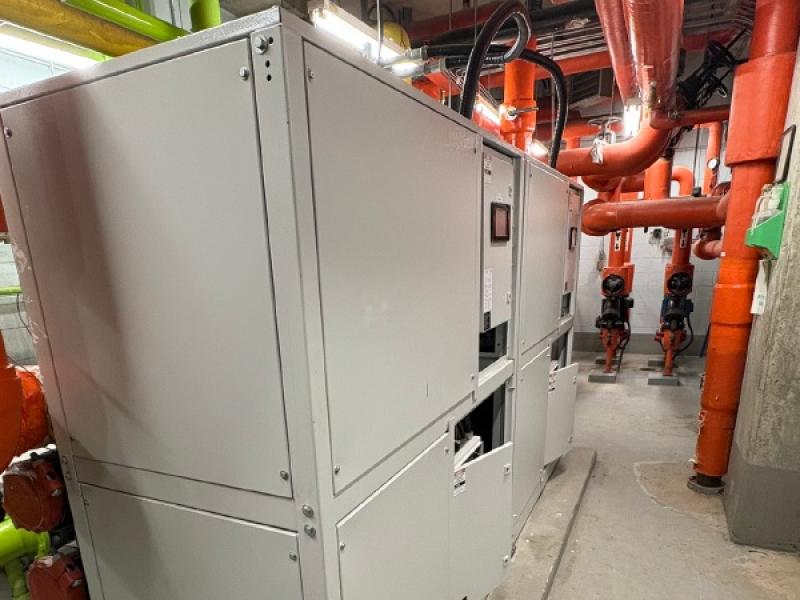
The report was accompanied by two case studies of deep retrofits so lessons could be shared. One of the reports concerned 33 Bloor St. E in Toronto, a 352,000-square-foot office and retail building managed by Toronto-based Epic Investment Services.
The building’s boiler was approaching its end-of-life in 2024, presenting an opportunity to decarbonize its heating system. Epic worked with Purpose to plan the project.
Facing limitations on space, electricity and finances, Epic made an effort to balance energy efficiency, decarbonization and costs, Nada Sutic, Epic’s vice-president of sustainability, innovation and national programs, said in an interview with Sustainable Biz Canada.
In the planning stage, three options for replacing the boilers were compared: new gas boilers, a mix of gas and electric boilers, and a heat recovery system with gas boiler back-ups. Epic chose the last option, which is expected to cut greenhouse gas emissions by 56 per cent with a payback period of over five years.
The manager of 33 Bloor St. E looked at the 20-year outlook of energy savings, carbon cuts and total capital costs to make its decision. “When we really looked at that, we felt that was a reasonable and prudent decision to make where it gives us some flexibility in the future,” Sutic said about choosing the heat recovery system.
How retrofit adoption can be boosted
Chisholm said there is a funding and financing gap for making deep retrofits in many buildings. It could be bridged with favourable financing from financial institutions and incentives from utilities and governments, he said.
There is also an opportunity to improve how the industry right-sizes deep retrofits, which would further trim costs, Chisholm noted.
He is also hoping the Purpose Retrofit Accelerator will receive more funding. The federal government’s funds will be exhausted in 12 months, Chisholm said, and building owners want it to continue.
For organizations interested in a deep retrofit, Sutic noted the importance of having the right stakeholders at the table early and ensuring the decision-making framework is understood by all early in the project.
“If you don’t do that, you can just stall projects,” she advised.




 Industry Events
 Locations