Locations






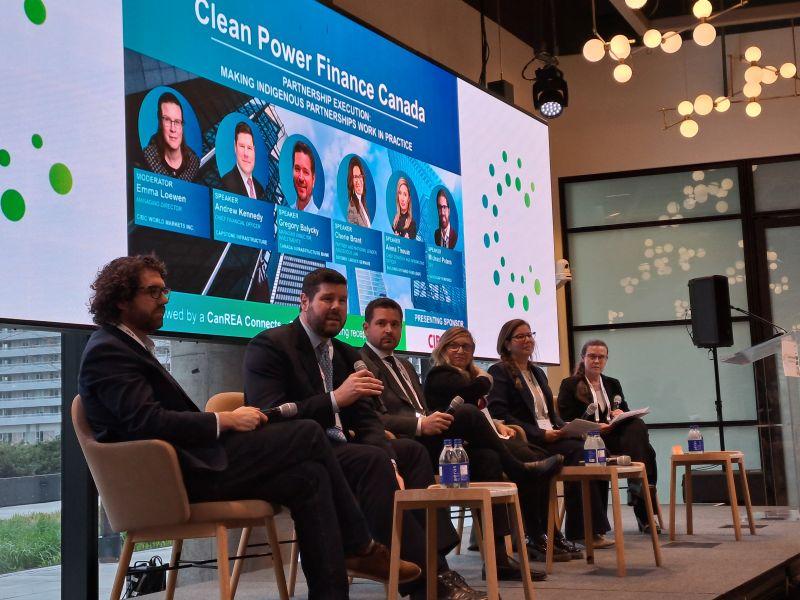
As Indigenous involvement in the Canadian renewables sector is becoming more commonplace, panellists at Clean Power Finance Canada laid out how to gain the approval of First Nations communities for clean energy projects.
The wind and solar farms and energy storage developments that Canada needs for its renewable energy capacity usually demand spacious tracts of land. These properties are often owned and governed by Indigenous Canadians as territories or reserves, an opportunity they are increasingly leveraging.
From 2009 to 2020, the number of renewables projects on Indigenous territory or reserve lands more than quadrupled, federal government data shows. Ownership – wholly or partially – has also ballooned over the period. For example, there was only three wholly owned Indigenous renewable projects from 2000 to 2009. That jumped to 15 from 2010 to 2020.
“Indigenous participation in the energy transition is not a negotiable item, it is a requirement,” Matt Jamieson, the CEO of the Six Nations of the Grand River Development Corporation (SNGRDC), said on the plenary panel of Clean Power Finance Canada, an industry event organized by the Canadian Renewable Energy Association and held last week in Toronto.
Though still facing barriers in accessing capital and working with unwilling host municipalities, “the fundamental viewpoint of most First Nations in Canada is they want to embrace this transition,” he said.
The SNGRDC is a major player in the clean energy sector with a 50 per cent equity in Canada’s largest battery energy storage facility located in Hagersville, Ont. It closed $700 million in funding for two more grid-scale batteries with Aypa Power in March.
Indigenous Canadians want bigger stakes in renewables
A report accompanying Clean Power Finance Canada described the $200-billion opportunity in the sector, and highlighted Indigenous involvement as key to the prospect.
Speakers on a panel about Indigenous partnerships concurred.
As a developer, Capstone Infrastructure believes “it’s good that it’s either a requirement or it’s economically uncompetitive in the procurements as a market signal,” its CFO Andrew Kennedy said. If an Indigenous community strongly supports a developer’s projects, it means a partner who will help derisk the venture.
There has been a shift in First Nations being involved only in consultation to wanting direct ownership, Cherie Brant, a partner and national leader of Indigenous law at law firm BLG, observed on the panel.
Years ago, the ownership stakes tended to be small at around three to 10 per cent, she said. Nowadays, more First Nations want to lead the development process and take a significant chunk of ownership.
Indigenous communities want “meaningful economics in the project, not just royalties, but actually participating in the project itself and the profits of the organization,” plus board seats and veto rights, Michael Peters, CEO of Glooscap Ventures, said on the panel.
Glooscap Ventures is the investment arm of the Glooscap First Nation in Nova Scotia. Renewable energy has been one of its focuses, with a major effort being co-development of the Weavers Mountain and Sugar Maple South wind projects with Halifax-based SWEB Development.
Additionally, Indigenous communities are searching for capacity building, Peters said, such as training youths to manage and maintain the renewable energy projects for decades to come.
Becoming part of the community
Understanding the needs of Indigenous Canadians and approaching them respectfully were noted as pivotal factors when developing projects on their lands.
Developers should ask Indigenous communities about their risk tolerance, Kennedy said. If they are unfamiliar with the energy sector, it is the developer’s responsibility to educate the community’s leadership about the market and the risks, he explained.
Kennedy encouraged having an open mind when writing a project bid. He warned about shopping that pitch against the First Nations in an area – “they all talk to each other, they know what’s going on. You’re not playing people off of each other.”
The most successful projects, Peters said, tend to be the ones where the developers “come and meet with us, even if they don’t have a project they’re thinking about.” Those companies, he continued, are the ones that attempt to establish trust years before broaching the economics. This could mean sponsoring and attending Indigenous cultural festivals.
“You’re partnering with a community, which (is) different from a company . . . We’re looking for a partner not only on the business side but also to be part of our community,” Peters said.
Alignment, due diligence, funding reform are needed
The panel’s moderator Emma Loewen, managing director of CIBC Capital Markets, asked the speakers where they see Indigenous partnerships most often fail.
Gregory Balycky, managing director of investments at the Canada Infrastructure Bank, said he sees projects struggling even after the request for proposal stage once the power purchase agreement is awarded. Overcoming this demands alignment with private sponsors and Indigenous communities on consultation, laying out pressure points and understanding the economic realities, he said.
Due diligence can help overcome the common pitfalls, Brant said. This could mean knowing the First Nations thoroughly, down to their politics such as whether they are in an election period or if a new council is being seated.
Easing, enabling and expediting funding for First Nation communities in the renewables sector is vital, Kennedy said.
“Having access during development allows them to behave and be on an equal footing. Having that money sooner is way better because they’re not as dependent on you as a funding provider.”


 Industry Events
 Locations