Locations





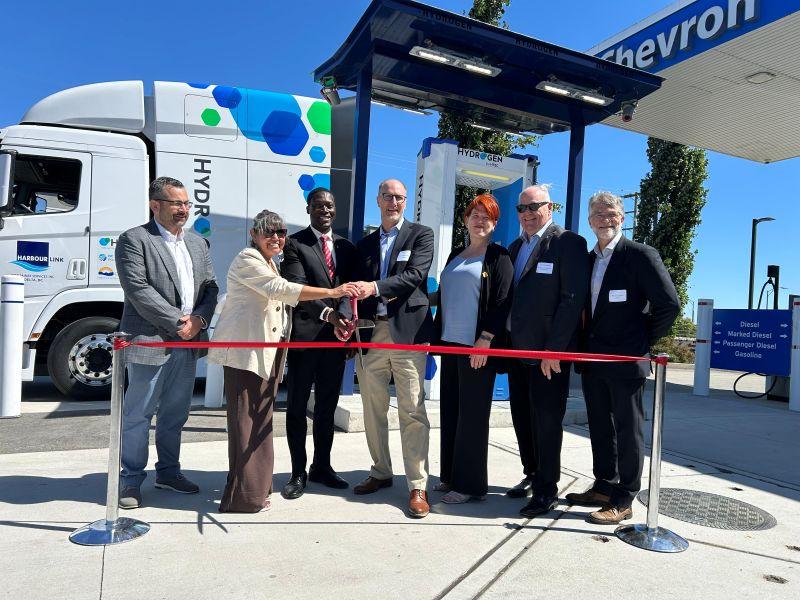
HTEC has cut the ribbon on what it says is Canada’s first commercial-scale hydrogen refuelling station of its calibre for heavy-duty trucks, located in the industrial port terminal of Delta, B.C.
Named the Tsawwassen Heavy-Duty Hydrogen Station, it can provide fuel for drayage and heavy-duty logistics powered by hydrogen at 350 and 700 bar of pressure. HTEC believes it is the first-of-its-kind in Canada to supply hydrogen at 700 bar.
The station supports deployment of a dozen Class 7 and 8 fuel-cell electric trucks funded through the B.C. Hydrogen Truck Pilot Project and the B.C. Hydrogen Ports Project.
Vancouver-based HTEC is supplying the station’s fuel from its Burnaby Clean Hydrogen Production facility, where approximately one tonne is made per day, combined with a liquid hydrogen subsystem that can provide up to an additional 800 kilograms per day.
“All in all, it marks an amazing day for HTEC . . . We’re focused on clean transportation, we’ve got to do something about it,” Colin Armstrong, president and CEO of HTEC, said in the opening ceremony held on a sunny Thursday morning.
Another link in HTEC’s hydrogen network
The station is in the Chevron Commercial Cardlock, located on Tsawwassen First Nation industrial lands, with the capacity to supply 400 kilograms of hydrogen per day.
Besides supplying Class 7 and 8 hydrogen trucks in freight and logistics associated with the port, the station can supply hydrogen-powered buses and trucks fuelled by both diesel and hydrogen, HTEC said.
At 700 bar of pressure, the fuel cell trucks can carry more fuel, travel farther and operate more efficiently, the company said, enhancing the case for freight applications. Armstrong said refuelling at 700 bar means a truck can be topped up to approximately 700 kilometres of range.
Sited on Tsawwassen territory, the station shows “what’s possible when we work together with a shared commitment to innovation, sustainability and respect for the land,” Laura Cassidy, chief of the Tsawwassen First Nation, said during the ceremony which included a performance by two Indigenous singers.
It not only supports economic development, but the long-term health of the local environment and future generations, she added.
The newly opened station serves as a node in HTEC’s hydrogen distribution network, which allows operators to have the confidence to invest in hydrogen, Armstrong said. That vision is embodied by the company’s Metro Vancouver Hydrogen Transportation Hub, which includes its Burnaby hydrogen production site and the planned North Vancouver Clean Liquid Hydrogen Facility.
HTEC operates six light-duty, retail hydrogen refuelling stations in British Columbia and a hydrogen fuel cell electric truck leasing business.
Hydrogen trucking in early phase
Hydrogen is being explored as a means to decarbonize transportation by replacing hydrocarbons such as gasoline and diesel. Instead of emitting greenhouse gases and pollution from the tailpipe when combusted, hydrogen results in water vapour.
For trucks, hydrogen fuel cells are light, energy efficient and can be refuelled in a relatively short time while incurring significant decarbonization, a 2024 report by the Pembina Institute concluded. The report compared and contrasted alternative fuel sources for medium- and heavy-duty trucks.
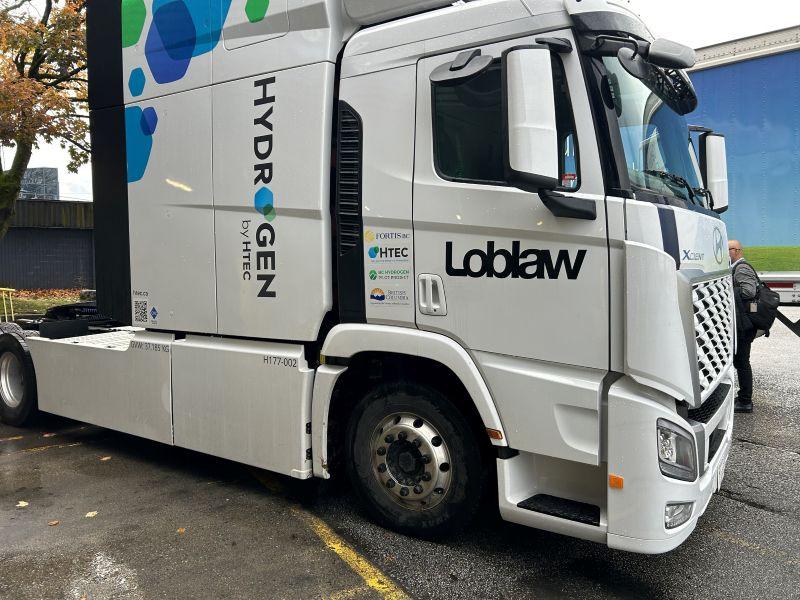
Companies trialling the use of hydrogen trucks in Canada include Loblaw in Vancouver with a Class 8 fuel-cell electric truck made by Hyundai, and Walmart in Mississauga with a Nikola Hydrogen Fuel Cell EV Class 8 truck with a range of approximately 800 kilometres.
However, hydrogen’s use in transportation remains highly limited today and more costly in comparison to fossil fuels. Companies like HTEC, backed with government funding, are attempting to overcome these hurdles.


 Industry Events
 Locations